2026
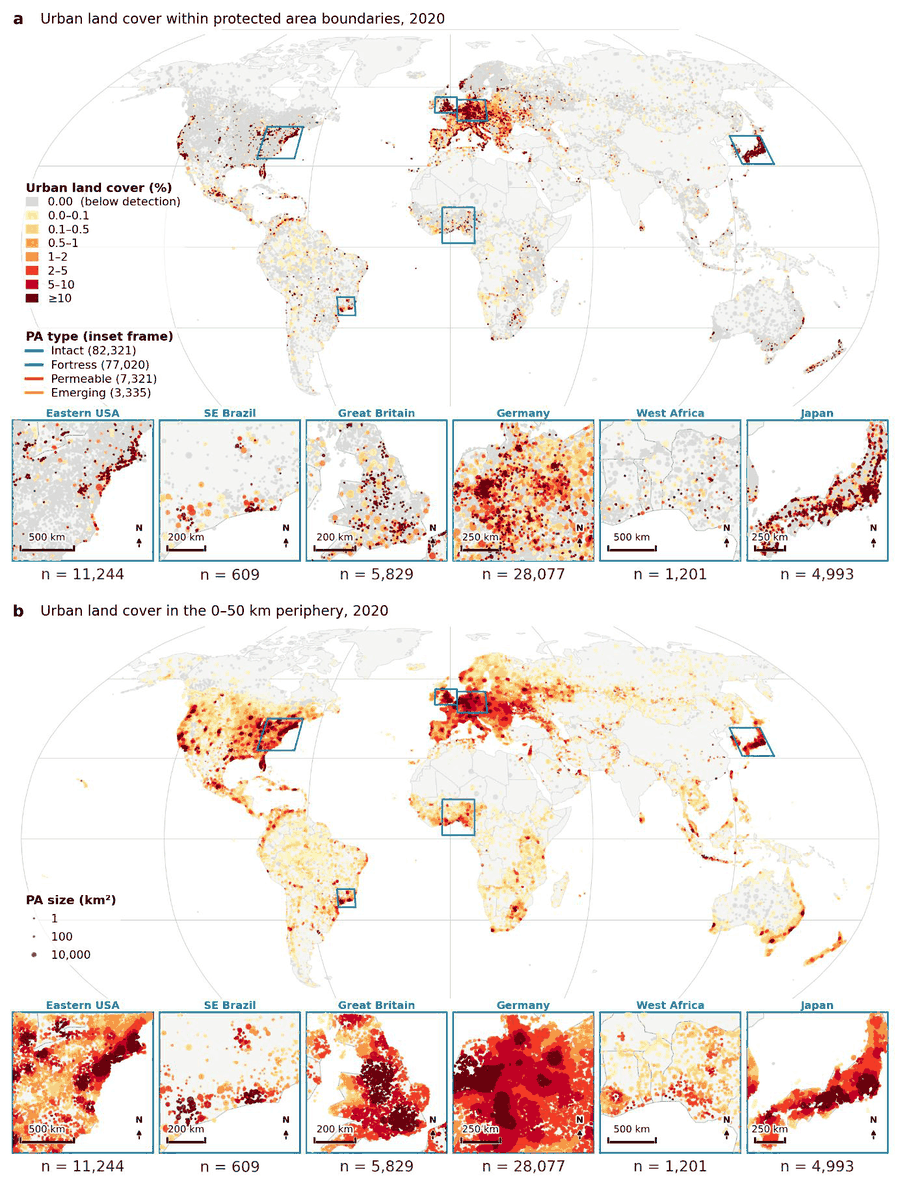
Two-thirds of the global protected areas are exposed to edge urbanizationIn Revision
I develop theories and methods to forecast where cities will grow and what that growth will cost — in habitat, in hazard exposure, in the systems people depend on — and, at Esri, build the spatial analysis and raster analysis tools that make those methods usable.
My doctoral research produced one of the first global-scale road network growth models, work AGU's Eos covered on publication. The same machinery now drives studies of protected-area isolation, species-range loss, and transport exposure to flooding across Brazil, Indonesia, Nigeria, Bangladesh, and Texas — 13+ peer-reviewed articles, 10+ more in review or in preparation, and 33+ conference presentations, held together by a preference for models that take spatial structure seriously and state their uncertainty plainly.
Co-convening the session at AGU 2026 in San Francisco, 7–11 December.
AGU Annual Meeting ↗A talk for the Esri GIS in Higher Education Chat, on getting more out of density analysis than a default heat map.
Session thread ↗Half the state's road and rail network sits in moderate-to-very-high flood susceptibility, and the hazard surface itself shifts under every SSP pathway.
Earth's Future ↗Urban land inside and around 169,997 protected areas, 1992 to 2020. The signal turns out to be at the edge rather than inside the boundary.
Read the preprint ↗What urban growth has cost habitat across Indonesia's 410 Key Biodiversity Areas, with Anushna Chaudhuri and Burak Güneralp.
Biological Conservation ↗A review of where urban land-change forecasting actually stands — 322 case study sites, and what the field still cannot answer.
npj Urban Sustainability ↗Theories and methods to forecast urban growth and what it costs — and the production tools that carry them to the people who need the answer.
10+ years developing theories and quantitative methods for how human activity builds and reshapes the built environment — and how that environment, in turn, acts on the land, the species, and the people living with it. The work spans quality assessment of heterogeneous forecast datasets, scenario-based baseline construction, and uncertainty quantification, published across 13+ peer-reviewed articles on land change, biodiversity outcomes, sustainability implications, and climate-driven infrastructure risk.
My doctoral research produced one of the first global-scale road network growth models — work AGU's Eos covered on publication — and the same machinery has since gone after protected-area isolation, species-range loss, and transport exposure to flooding across Brazil, Indonesia, Nigeria, Bangladesh, and Texas. Earlier consulting work delivered environmental and social impact assessments and resettlement planning for multilateral development bank infrastructure projects, and field data collection on climate-driven displacement for an international development agency.
At Esri, I develop production spatial analysis and raster analysis tools, technical specifications and documentation, along with the data pipelines, dashboards, blogs, and hub sites that deliver analytical results to non-technical users. I hold a PhD in Geography and the GISP certification, and co-convene the AGU Urban Area and Global Change session in 2026.
My work follows a single line of inquiry: how urban expansion and road networks reshape landscapes, and what that change means for the species and people who share them. Alongside the research I design and document the spatial analysis and raster analysis tooling that others use to ask questions of the same kind.
Before joining Esri in 2024 I completed a PhD in Geography at Texas A&M, advised by Burak Güneralp. Earlier came two master's degrees from Iowa State — Community and Regional Planning, and Transportation — with a graduate certificate in GIS along the way, and an undergraduate degree in Urban and Rural Planning from Khulna University. The planning identity runs underneath everything I do.
Recent collaborators include Burak Güneralp, İnci Güneralp, and Lee A. Fitzgerald at Texas A&M, M Mahbub Hossain at the University of Houston, and the Oak Ridge National Laboratory Human Geography Group.
Where, how fast, and at what cost the world's cities are growing. Long time-series across Bangladesh, Indonesia, and 19 world regions under SSP scenarios.
The first global-scale road network growth model, featured by AGU's Eos. Forecasting where new roads will appear and what landscapes they will cross.
How urban expansion and roads isolate protected-area networks and threatened species ranges. Brazil, Indonesia, Nigeria, Bangladesh.
How human activities — settlements, roads, infrastructure — interact with biophysical systems. Where pressure accumulates, what couplings emerge, and what those imply for sustainability.
Spatial methods applied to public health. Earlier work mapped COVID-19 spread, examined geospatial methods in research on homeless populations, and reviewed the role of GIS in pandemic decision-making.
Machine learning, statistical, and process-based models for spatial problems. From hedonic regression to XGBoost land-cover classification, AI-based flood susceptibility, and urban–transport coevolution.
The craft underneath the results: checking results against independently built datasets, hazard modelling that carries its own uncertainty, and measuring how well transit networks actually reach people.
Before the method, the question I keep coming back to is why this, and what follows from it — who the answer is for, what decision it could change, and what it would cost to be wrong.
A global model is only interesting if someone can act on it. So the work starts with the implication rather than the technique: if urban growth is pressing in on two-thirds of the world's protected areas, that is a conservation-planning problem before it is a statistics problem. If half of Texas' road and rail network sits in moderate-to-high flood susceptibility, that is a maintenance-budget problem. Keeping that end in view is what decides which version of a question is worth asking, and it is why the three habits below matter — each one protects the answer at the point where it would otherwise mislead someone.
Neighbours are not independent observations. Where things sit relative to each other is usually the finding, not a nuisance to correct away — a map of where an effect concentrates tells me more than a single coefficient averaged over everywhere.
When the sample runs to every protected area on Earth, almost anything comes out statistically significant, so significance alone says nothing. How big the effect is, how confident we can be, and whether it survives a change of assumptions all go in alongside the headline number.
One land-cover product is a hypothesis. I check results against independently produced datasets, compare model output to FEMA hazard maps and ROC curves, and say plainly where they disagree rather than picking the version that flatters the argument.
Most of what I work on comes back to one question — how do cities reshape the planet? — approached from four directions. If your question sits near any of these, I would like to hear about it.
Where cities have already grown and where they are going next, reconstructed from multi-decadal land-cover series and projected under SSP scenarios — from single metropolitan areas through world regions to the global total. Each scale answers a different question, and I care about keeping those differences visible rather than averaging them into one curve.
Transportation usually enters land-change models as a fixed input. My work treats road growth as something to forecast in its own right, because knowing where new roads appear tells you where forests open and where new hazard exposure accumulates.
What urban and road expansion do to species ranges, Key Biodiversity Areas, and the landscapes immediately outside protected boundaries. Increasingly the interesting signal is at the edge rather than inside the line on the map.
How built systems sit relative to flooding and other hazards, and the methodological questions underneath — scale, product choice, validation, and how to report uncertainty when the sample is large enough to make everything significant.
Beyond the areas above, I am glad to discuss potential collaborations, questions about published work, the graduate school and early-career research journey, and Earth and environmental science research more broadly. A short note on your question and the data behind it helps me reply usefully.